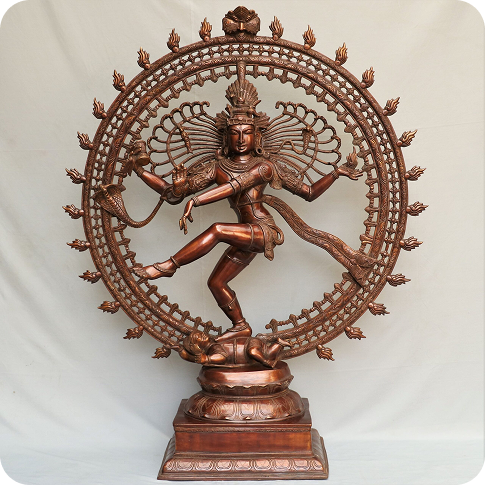
In the annals of science,18 June 2004 is an important date, especially regarding India. The Government of India had presented CERN (The European Organization for Nuclear Research) at Geneva, Switzerland, with a statue of Nataraja, the dancing Shiva. This was a memento to celebrate India’s association with this prestigious laboratory since 1960.
The European Organization for Nuclear Research, known as CERN, is a research organization that operates the largest particle physics laboratory in the world. Established in 1954, the organization is based in a northwest suburb of Geneva on the Franco-Swiss border.
Shiva, who is also known as Nataraja symbolises the ‘life force’ has a statue at CERN, Switzerland, home to the Large Hadron Collider. The cosmic dance or the Nataraja is purely related to the Anti-matter research done at CERN. It has creative and destructive power. All his various dance postures symbolise the creation, preservation and destruction of the universe.
The famous cosmologist, Carl Sagan too drew an interesting correlation between the theories of modern cosmology and dancing Shiva, Nataraja. In his famous book Cosmos, Sagan says, “The Hindu religion is the only one of the world’s great faiths dedicated to the idea that the Cosmos itself undergoes an immense, indeed an infinite, number of deaths and rebirths. It is the only religion in which the time scales correspond to those of modern scientific cosmology.
Let’s dive in to understand the meaning behind Lord Nataraja… There is meaning, depth and learning for business, its leaders and life in general. Nataraja, or Lord of the Dance (nata = dance; raja = king or lord), is one of the most popular iconic forms of SHIVA. In his cosmic dance, he creates, sustains, and eventually destroys the universe. When Shiva’s dance is seen as symbolizing only the end of time, it is called the Tandava dance
The sculpture is usually made in bronze, with Shiva dancing in an aureole of flames, lifting his left leg and balancing over a demon or dwarf (Apasmara) who symbolizes ignorance. It is a well-known sculptural symbol in India and popularly used as a symbol of Indian culture.
The two most common forms of Shiva’s dance are the Lasya (the gentle form of dance), and the Tandava (the violent and dangerous dance), associated with the destruction of weary world-views - weary perspectives & lifestyles. In essence, the Lasya and the Tandava are just two aspects of Shiva’s nature; for he destroys in order to create, tearing down to build again.